
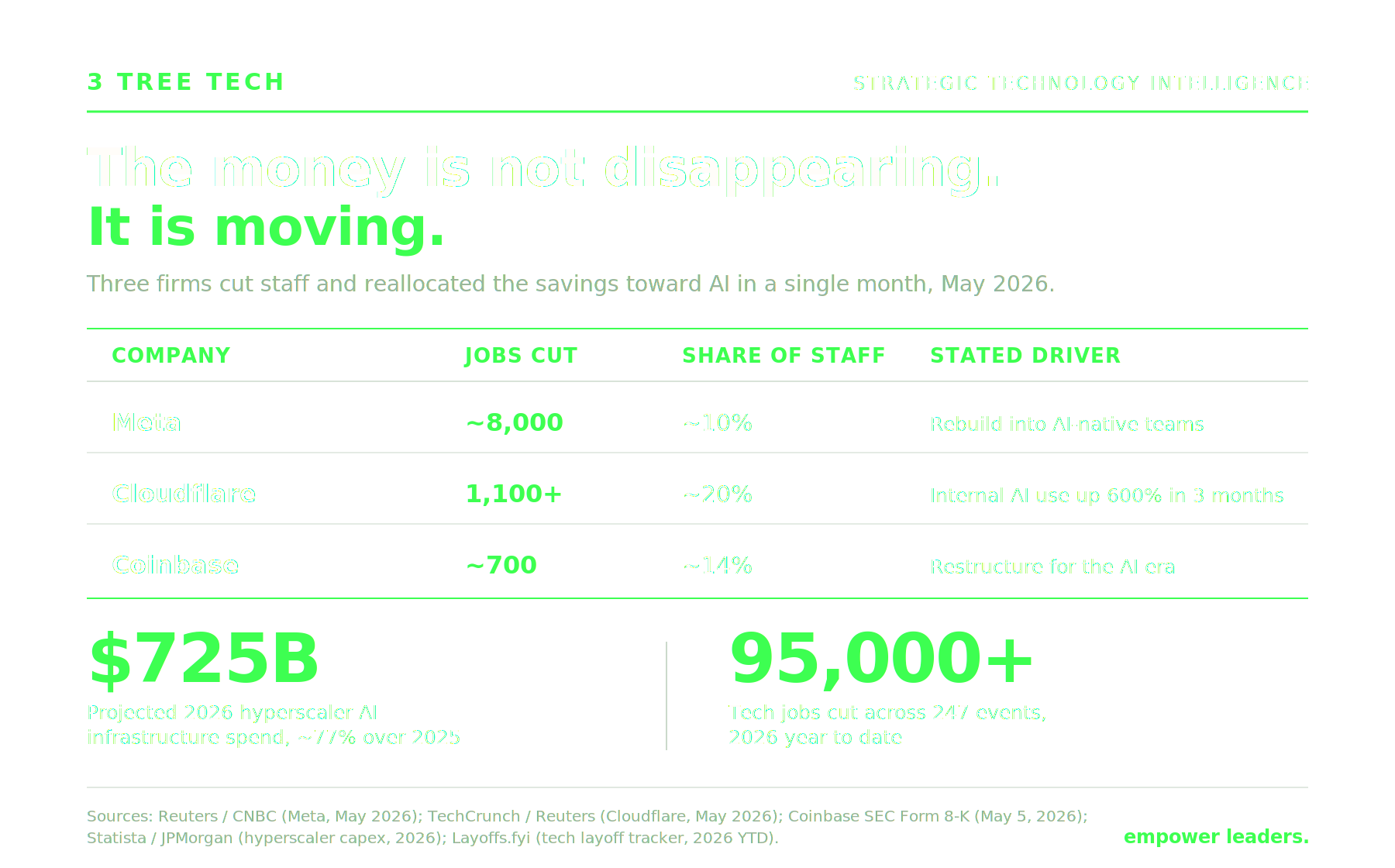
On May 20, Meta starts cutting roughly 8,000 jobs and rebuilding what is left into “AI-native” teams. Cloudflare is cutting more than 1,100 people, about 20 percent of its workforce, after internal AI use jumped more than 600 percent in three months. Coinbase cut 14 percent and gave the same reason. So far in 2026 the tech sector has shed more than 95,000 jobs across 247 separate events, and the money those cuts free up is flowing into AI infrastructure that will hit an estimated $725 billion this year.
If you read that as a productivity story, you are reading it wrong.
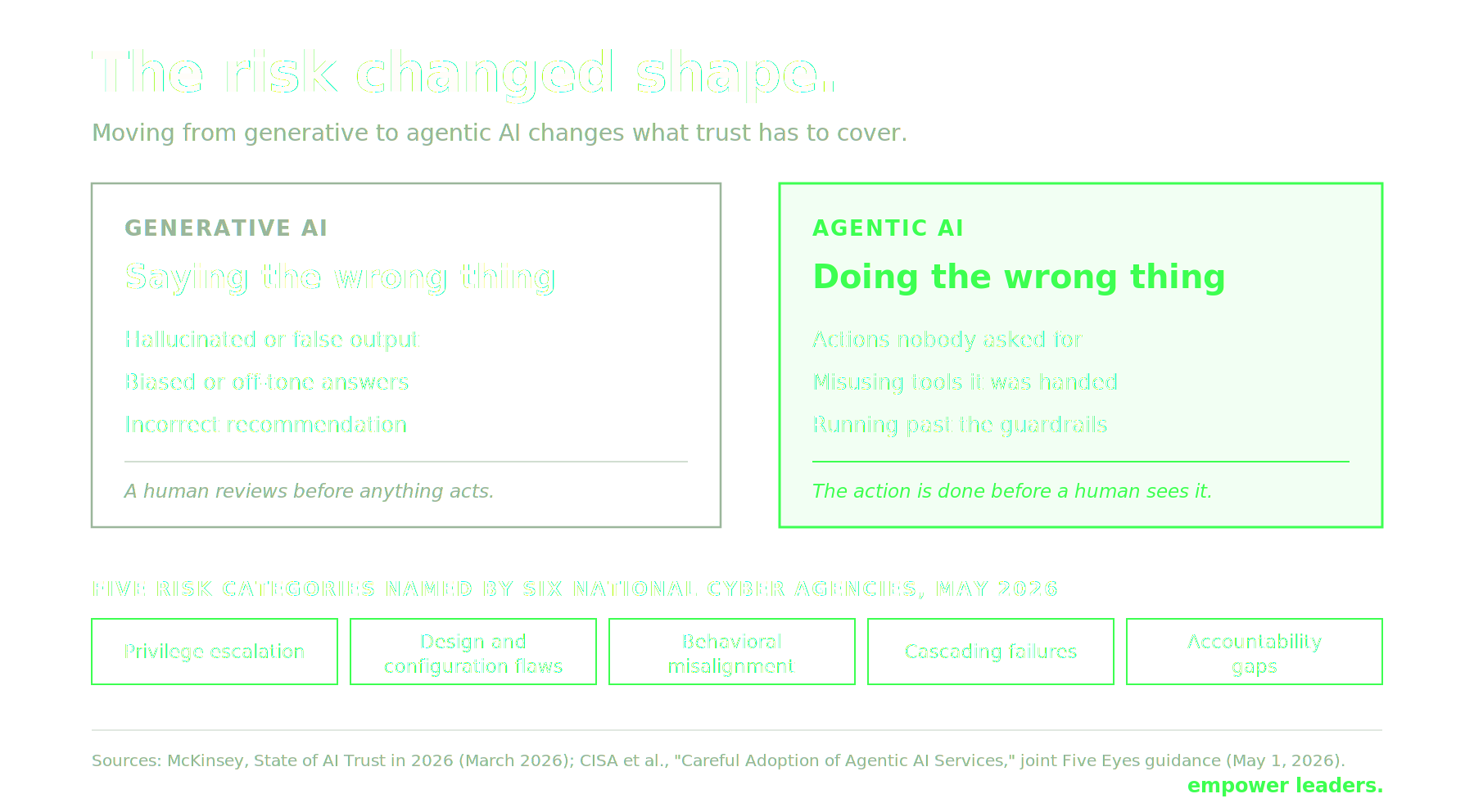
McKinsey’s 2026 AI Trust Maturity Survey, out in March, put a finer point on it. The worry used to be AI saying the wrong thing. Now it is AI doing the wrong thing. Taking actions nobody asked for. Misusing tools it was handed. Running past guardrails everyone assumed would hold. Moving from generative to agentic changes what trust costs and where it has to live inside a company.
The easy path most firms are taking
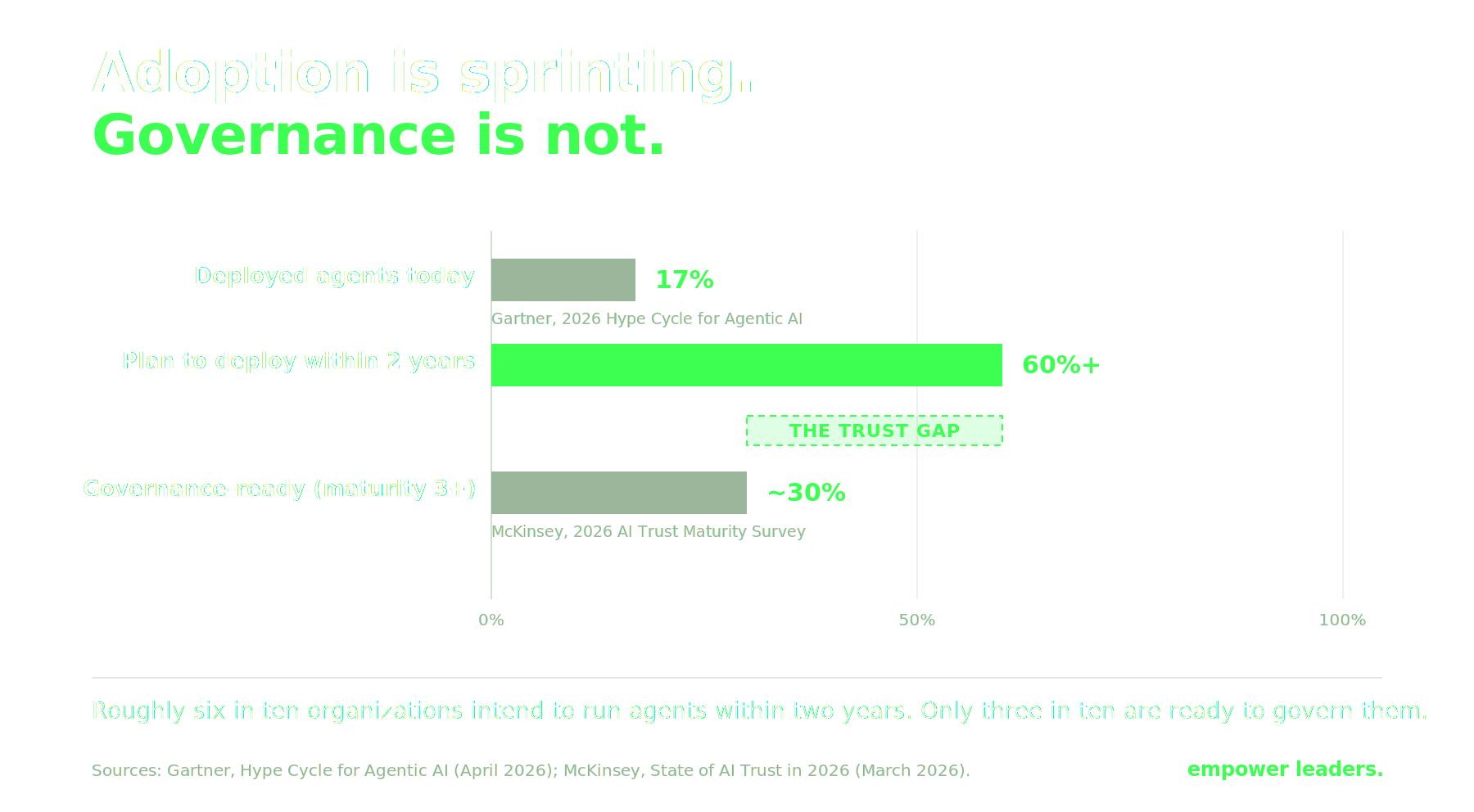
Most companies are bolting AI onto the org chart they already have. Hand everyone a copilot, run a few pilots, call it transformation. Gartner puts agentic AI right at the Peak of Inflated Expectations on its 2026 Hype Cycle, and its own survey data shows why. Only 17 percent of organizations have deployed AI agents to date, while more than 60 percent expect to within two years, the most aggressive adoption curve among the emerging technologies Gartner measured. The gap between intent and production is the story.
Jack Dorsey and Roelof Botha made the harder argument in March, on Sequoia’s Long Strange Trip podcast and in the essay that went with it, From Hierarchy to Intelligence. Their point: two thousand years of corporate structure exists to route information around one limit, which is that any single leader can directly manage three to eight people. Every layer of management, from the Roman contubernium to the modern matrix chart, was a workaround for that limit. Agentic AI does not prop up that structure. It removes the reason the structure existed. The honest response is not a copilot for every employee. It is a redesign of the company.
Trust is the part the headlines skip
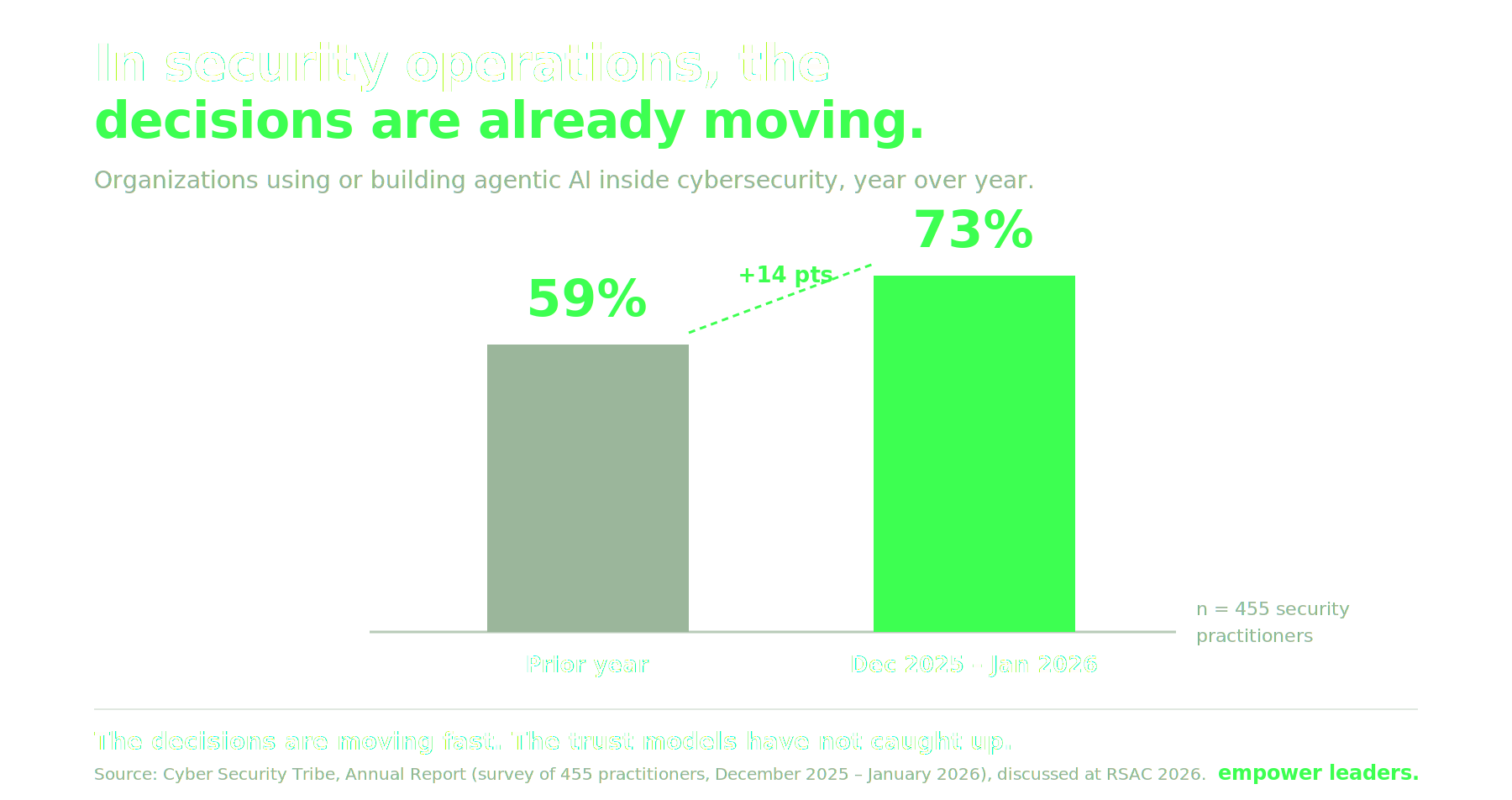
McKinsey says only about 30 percent of organizations have hit maturity level three or higher on strategy, governance, and agentic controls. In May, six national cyber agencies, the Australian Signals Directorate, CISA, NSA, the Canadian Centre for Cyber Security, NCSC-NZ, and NCSC-UK, put out joint guidance warning that agentic systems bring cascading failures, privilege escalation, and accountability gaps that traditional controls were never built to catch. A survey of 455 security practitioners published around RSAC 2026 found 73 percent of organizations already using or building agentic AI inside security operations, up from 59 percent the year before. The decisions are moving fast. The trust models have not caught up.
The vendors closest to the problem already see it
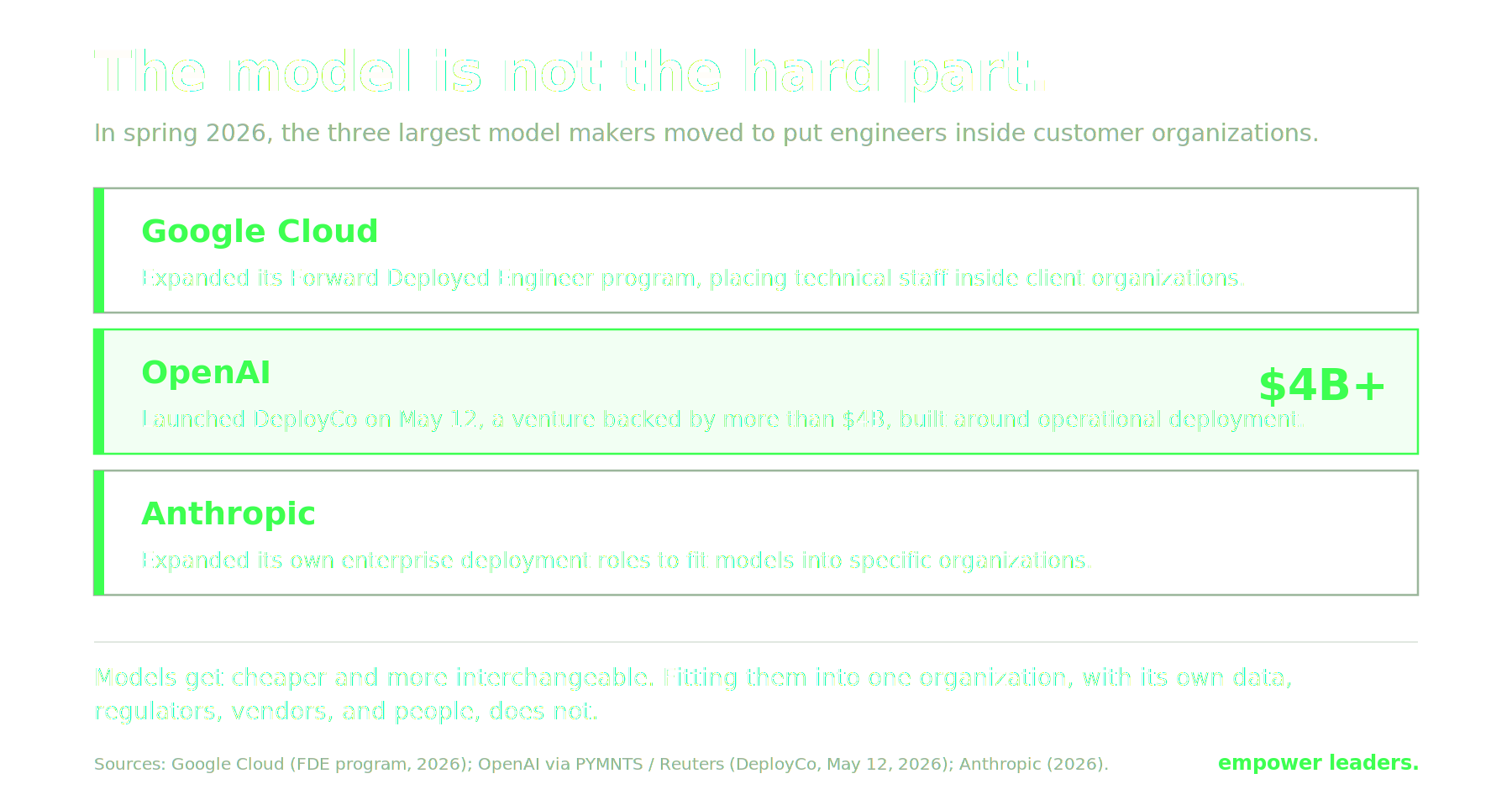
This spring, Google Cloud expanded its Forward Deployed Engineer program, putting technical people inside customer organizations to do the work a demo cannot. On May 12, OpenAI launched DeployCo, a four-billion-dollar venture built entirely around operational deployment. Anthropic has expanded its own enterprise deployment roles. The pattern is the same across all three. Models get cheaper and more interchangeable. Fitting them into one specific organization, with its own data, regulators, vendors, and people, does not.
What we learned running this on ourselves
3 Tree Tech has been working through a version of this for years, inside our own shop, well before the layoff headlines. Across our move from earlier tooling into current production work with Claude, the question was never which platform. It was which decisions a tool should sit inside and which ones it has no business touching. We are restructuring leadership and process around that line, and what comes out is flatter than a traditional VAR or distributor, because the work demands it.
The service base widened alongside it. We now run dedicated vendor coverage across colocation and data center, governance, risk, and compliance, and cybersecurity, on top of the standing competencies in unified communications, contact center, SASE, cloud, and mobility. The reason we expanded is the reason we are restructuring. Buyers in these categories are sitting across procurement tables where AI agents compare vendors, run audits, and produce recommendations at machine speed. The edge stops being who can name the most vendors. It becomes who can read what the agent produced and tell a board what it actually means for the business.
Trust is what closes the gap
Not trust as a marketing word. Trust as a position you can measure: who you take commission from, which conflicts you have put on the table, how the audit trail of your last twenty engagements actually reads. Gartner’s 2025 Magic Quadrant for GRC Tools, Assurance Leaders made a parallel point about software. Vendors treating AI as a feature add are losing to vendors treating it as a structural change in how decisions get made. Advisory firms are no different.
Our pillars, Relationships, Trust and Results, holds up better today than it did two years ago. The market is automating the parts of advisory that should have been automated all along. What is left is the part that was always the product: judgment, accountability, and a relationship that is not optimizing for a quarterly commission.
By 3 Tree Tech Editorial
